 Add to Chrome
 Add to Firefox
 Add to Edge
automatic modulation classification
Papers and Code
Selective Fine-Tuning of GPT Architectures for Parameter-Efficient Clinical Text Classification
Mar 15, 2026
The rapid expansion of electronic health record (EHR) systems has generated large volumes of unstructured clinical narratives that contain valuable information for disease identification, patient cohort discovery, and clinical decision support. Extracting structured knowledge from these free-text documents remains challenging because clinical language is highly specialized, labeled datasets are limited, and full fine-tuning of large pretrained language models can require substantial computational resources. Efficient adaptation strategies are therefore essential for practical clinical natural language processing applications. This study proposes a parameter-efficient selective fine-tuning framework for adapting GPT-2 to clinical text classification tasks. Instead of updating the entire pretrained model, the majority of network parameters are frozen, and only the final Transformer block, the final layer normalization module, and a lightweight classification head are updated during training. This design substantially reduces the number of trainable parameters while preserving the contextual representation capabilities learned during pretraining. The proposed approach is evaluated using radiology reports from the MIMIC-IV-Note dataset with automatically derived CheXpert-style labels. Experiments on 50,000 radiology reports demonstrate that selective fine-tuning achieves approximately 91% classification accuracy while updating fewer than 6% of the model parameters. Comparative experiments with head-only training and full-model fine-tuning show that the proposed method provides a favorable balance between predictive performance and computational efficiency. These results indicate that selective fine-tuning offers an efficient and scalable framework for clinical text classification.

AIMC-Spec: A Benchmark Dataset for Automatic Intrapulse Modulation Classification under Variable Noise Conditions
Jan 13, 2026A lack of standardized datasets has long hindered progress in automatic intrapulse modulation classification (AIMC) - a critical task in radar signal analysis for electronic support systems, particularly under noisy or degraded conditions. AIMC seeks to identify the modulation type embedded within a single radar pulse from its complex in-phase and quadrature (I/Q) representation, enabling automated interpretation of intrapulse structure. This paper introduces AIMC-Spec, a comprehensive synthetic dataset for spectrogram-based image classification, encompassing 33 modulation types across 13 signal-to-noise ratio (SNR) levels. To benchmark AIMC-Spec, five representative deep learning algorithms - ranging from lightweight CNNs and denoising architectures to transformer-based networks - were re-implemented and evaluated under a unified input format. The results reveal significant performance variation, with frequency-modulated (FM) signals classified more reliably than phase or hybrid types, particularly at low SNRs. A focused FM-only test further highlights how modulation type and network architecture influence classifier robustness. AIMC-Spec establishes a reproducible baseline and provides a foundation for future research and standardization in the AIMC domain.
Neural Sentinel: Unified Vision Language Model (VLM) for License Plate Recognition with Human-in-the-Loop Continual Learning
Feb 04, 2026Traditional Automatic License Plate Recognition (ALPR) systems employ multi-stage pipelines consisting of object detection networks followed by separate Optical Character Recognition (OCR) modules, introducing compounding errors, increased latency, and architectural complexity. This research presents Neural Sentinel, a novel unified approach that leverages Vision Language Models (VLMs) to perform license plate recognition, state classification, and vehicle attribute extraction through a single forward pass. Our primary contribution lies in demonstrating that a fine-tuned PaliGemma 3B model, adapted via Low-Rank Adaptation (LoRA), can simultaneously answer multiple visual questions about vehicle images, achieving 92.3% plate recognition accuracy, which is a 14.1% improvement over EasyOCR and 9.9% improvement over PaddleOCR baselines. We introduce a Human-in-the-Loop (HITL) continual learning framework that incorporates user corrections while preventing catastrophic forgetting through experience replay, maintaining a 70:30 ratio of original training data to correction samples. The system achieves a mean inference latency of 152ms with an Expected Calibration Error (ECE) of 0.048, indicating well calibrated confidence estimates. Additionally, the VLM first architecture enables zero-shot generalization to auxiliary tasks including vehicle color detection (89%), seatbelt detection (82%), and occupancy counting (78%) without task specific training. Through extensive experimentation on real world toll plaza imagery, we demonstrate that unified vision language approaches represent a paradigm shift in ALPR systems, offering superior accuracy, reduced architectural complexity, and emergent multi-task capabilities that traditional pipeline approaches cannot achieve.
GenAI for Social Work Field Education: Client Simulation with Real-Time Feedback
Jan 26, 2026Field education is the signature pedagogy of social work, yet providing timely and objective feedback during training is constrained by the availability of instructors and counseling clients. In this paper, we present SWITCH, the Social Work Interactive Training Chatbot. SWITCH integrates realistic client simulation, real-time counseling skill classification, and a Motivational Interviewing (MI) progression system into the training workflow. To model a client, SWITCH uses a cognitively grounded profile comprising static fields (e.g., background, beliefs) and dynamic fields (e.g., emotions, automatic thoughts, openness), allowing the agent's behavior to evolve throughout a session realistically. The skill classification module identifies the counseling skills from the user utterances, and feeds the result to the MI controller that regulates the MI stage transitions. To enhance classification accuracy, we study in-context learning with retrieval over annotated transcripts, and a fine-tuned BERT multi-label classifier. In the experiments, we demonstrated that both BERT-based approach and in-context learning outperforms the baseline with big margin. SWITCH thereby offers a scalable, low-cost, and consistent training workflow that complements field education, and allows supervisors to focus on higher-level mentorship.
A Light Weight Neural Network for Automatic Modulation Classification in OFDM Systems
Dec 26, 2025Automatic Modulation Classification (AMC) is a vital component in the development of intelligent and adaptive transceivers for future wireless communication systems. Existing statistically-based blind modulation classification methods for Orthogonal Frequency Division Multiplexing (OFDM) often fail to achieve the required accuracy and performance. Consequently, the modulation classification research community has shifted its focus toward deep learning techniques, which demonstrate promising performance, but come with increased computational complexity. In this paper, we propose a lightweight subcarrier-based modulation classification method for OFDM systems. In the proposed approach, a selected set of subcarriers in an OFDM frame is classified first, followed by the prediction of the modulation types for the remaining subcarriers based on the initial results. A Lightweight Neural Network (LWNN) is employed to identify the initially selected set of subcarriers, and its output is fed into a Recurrent Neural Network (RNN) as an embedded vector to predict the modulation schemes of the remaining subcarriers in the OFDM frame.
Tissue Classification and Whole-Slide Images Analysis via Modeling of the Tumor Microenvironment and Biological Pathways
Jan 13, 2026Automatic integration of whole slide images (WSIs) and gene expression profiles has demonstrated substantial potential in precision clinical diagnosis and cancer progression studies. However, most existing studies focus on individual gene sequences and slide level classification tasks, with limited attention to spatial transcriptomics and patch level applications. To address this limitation, we propose a multimodal network, BioMorphNet, which automatically integrates tissue morphological features and spatial gene expression to support tissue classification and differential gene analysis. For considering morphological features, BioMorphNet constructs a graph to model the relationships between target patches and their neighbors, and adjusts the response strength based on morphological and molecular level similarity, to better characterize the tumor microenvironment. In terms of multimodal interactions, BioMorphNet derives clinical pathway features from spatial transcriptomic data based on a predefined pathway database, serving as a bridge between tissue morphology and gene expression. In addition, a novel learnable pathway module is designed to automatically simulate the biological pathway formation process, providing a complementary representation to existing clinical pathways. Compared with the latest morphology gene multimodal methods, BioMorphNet's average classification metrics improve by 2.67%, 5.48%, and 6.29% for prostate cancer, colorectal cancer, and breast cancer datasets, respectively. BioMorphNet not only classifies tissue categories within WSIs accurately to support tumor localization, but also analyzes differential gene expression between tissue categories based on prediction confidence, contributing to the discovery of potential tumor biomarkers.
Uni-Fi: Integrated Multi-Task Wi-Fi Sensing
Jan 16, 2026Wi-Fi sensing technology enables non-intrusive, continuous monitoring of user locations and activities, which supports diverse smart home applications. Since different sensing tasks exhibit contextual relationships, their integration can enhance individual module performance. However, integrating sensing tasks across different research efforts faces challenges due to the absence of two key elements. The first is a unified architecture that captures the fundamental nature shared across diverse sensing tasks. The second is an extensible pipeline that can integrate sensing methodologies proposed in potential future research. This paper presents Uni-Fi, an extensible framework for multi-task Wi-Fi sensing integration. This paper makes the following contributions. First, we propose a unified theoretical framework that reveals the fundamental differences between single-task and multi-task sensing. Second, we develop a scalable sensing pipeline that automatically generates multi-task sensing solvers, enabling seamless integration of multiple sensing models. Experimental results show that Uni-Fi achieves robust performance across tasks, with a localization error of approximately 0.54 meters, 98.34 percent accuracy for activity classification, and 98.57 percent accuracy for presence detection.
Interference Mitigation Recommender System using U-Net Autoencoders
Dec 15, 2025Building on the previous work on interference mitigation, this paper introduces a modular recommender system that automatically selects the most effective interference mitigation strategy based on the interference characteristics present in the received signal. The system integrates three key stages: an SPS classifier module, a SIR predictor, and a bank of specialized U-Net autoencoders designed for different interference conditions. The classification block identifies the parameters required for cancellation. The recommender then directs the signal to the appropriate mitigation model, optionally incorporating SIR-based decisions for scenarios where successive interference cancellation may be advantageous. Experiments conducted across diverse SIR levels and modulation environments show that the recommender strategy improves robustness and reduces BER compared to using any single mitigation method alone. The results demonstrate the potential of adaptive, model-selective architectures to enhance interference resilience in dynamic communication environments.
MelanomaNet: Explainable Deep Learning for Skin Lesion Classification
Dec 10, 2025Automated skin lesion classification using deep learning has shown remarkable accuracy, yet clinical adoption remains limited due to the "black box" nature of these models. We present MelanomaNet, an explainable deep learning system for multi-class skin lesion classification that addresses this gap through four complementary interpretability mechanisms. Our approach combines an EfficientNet V2 backbone with GradCAM++ attention visualization, automated ABCDE clinical criterion extraction, Fast Concept Activation Vectors (FastCAV) for concept-based explanations, and Monte Carlo Dropout uncertainty quantification. We evaluate our system on the ISIC 2019 dataset containing 25,331 dermoscopic images across 9 diagnostic categories. Our model achieves 85.61% accuracy with a weighted F1 score of 0.8564, while providing clinically meaningful explanations that align model attention with established dermatological assessment criteria. The uncertainty quantification module decomposes prediction confidence into epistemic and aleatoric components, enabling automatic flagging of unreliable predictions for clinical review. Our results demonstrate that high classification performance can be achieved alongside comprehensive interpretability, potentially facilitating greater trust and adoption in clinical dermatology workflows. The source code is available at https://github.com/suxrobgm/explainable-melanoma
Cross-modal ultra-scale learning with tri-modalities of renal biopsy images for glomerular multi-disease auxiliary diagnosis
Dec 17, 2025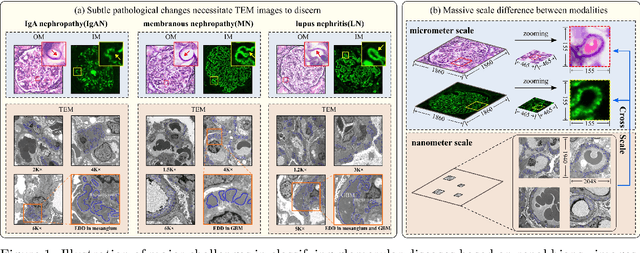
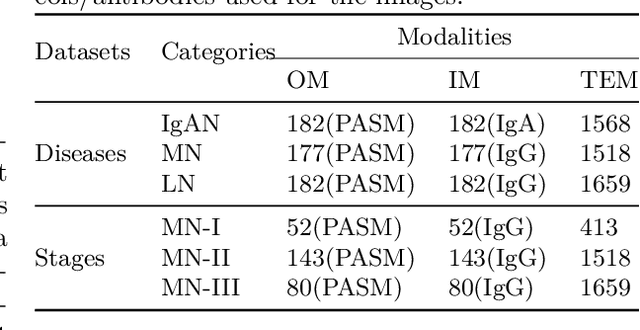
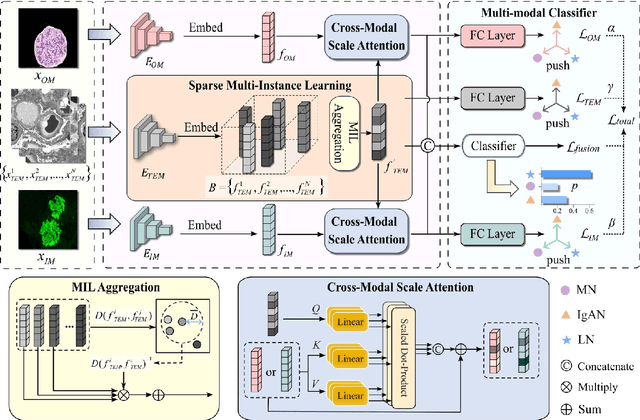
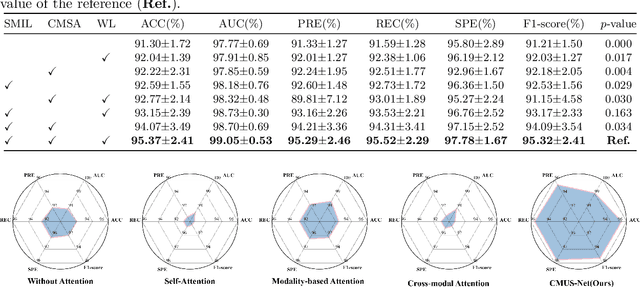
Constructing a multi-modal automatic classification model based on three types of renal biopsy images can assist pathologists in glomerular multi-disease identification. However, the substantial scale difference between transmission electron microscopy (TEM) image features at the nanoscale and optical microscopy (OM) or immunofluorescence microscopy (IM) images at the microscale poses a challenge for existing multi-modal and multi-scale models in achieving effective feature fusion and improving classification accuracy. To address this issue, we propose a cross-modal ultra-scale learning network (CMUS-Net) for the auxiliary diagnosis of multiple glomerular diseases. CMUS-Net utilizes multiple ultrastructural information to bridge the scale difference between nanometer and micrometer images. Specifically, we introduce a sparse multi-instance learning module to aggregate features from TEM images. Furthermore, we design a cross-modal scale attention module to facilitate feature interaction, enhancing pathological semantic information. Finally, multiple loss functions are combined, allowing the model to weigh the importance among different modalities and achieve precise classification of glomerular diseases. Our method follows the conventional process of renal biopsy pathology diagnosis and, for the first time, performs automatic classification of multiple glomerular diseases including IgA nephropathy (IgAN), membranous nephropathy (MN), and lupus nephritis (LN) based on images from three modalities and two scales. On an in-house dataset, CMUS-Net achieves an ACC of 95.37+/-2.41%, an AUC of 99.05+/-0.53%, and an F1-score of 95.32+/-2.41%. Extensive experiments demonstrate that CMUS-Net outperforms other well-known multi-modal or multi-scale methods and show its generalization capability in staging MN. Code is available at https://github.com/SMU-GL-Group/MultiModal_lkx/tree/main.